
Why Traditional Approaches Struggle
Vacant and distressed homes often require significant legal, structural, and financial work before they can return to productive use. Traditional public rehabilitation approaches frequently place the full cost and risk of this work on public agencies.
These projects can involve high upfront expenses, long timelines, and uncertainty tied to legal barriers such as unclear title, probate, and liens. As a result, fewer homes can be addressed with limited public resources.
How the Wilkinsburg Land Bank Model Works
The Wilkinsburg Land Bank focuses public investment where it has the greatest impact:
Clearing legal barriers
Stabilizing properties, and
Preparing them for responsible reuse
Rather than funding full rehabilitation, the Land Bank enables private homeowners, mission-aligned developers, and contractors to complete renovations. This approach stretches public dollars further while accelerating neighborhood reinvestment.
“Average public investment per property: $17,950”
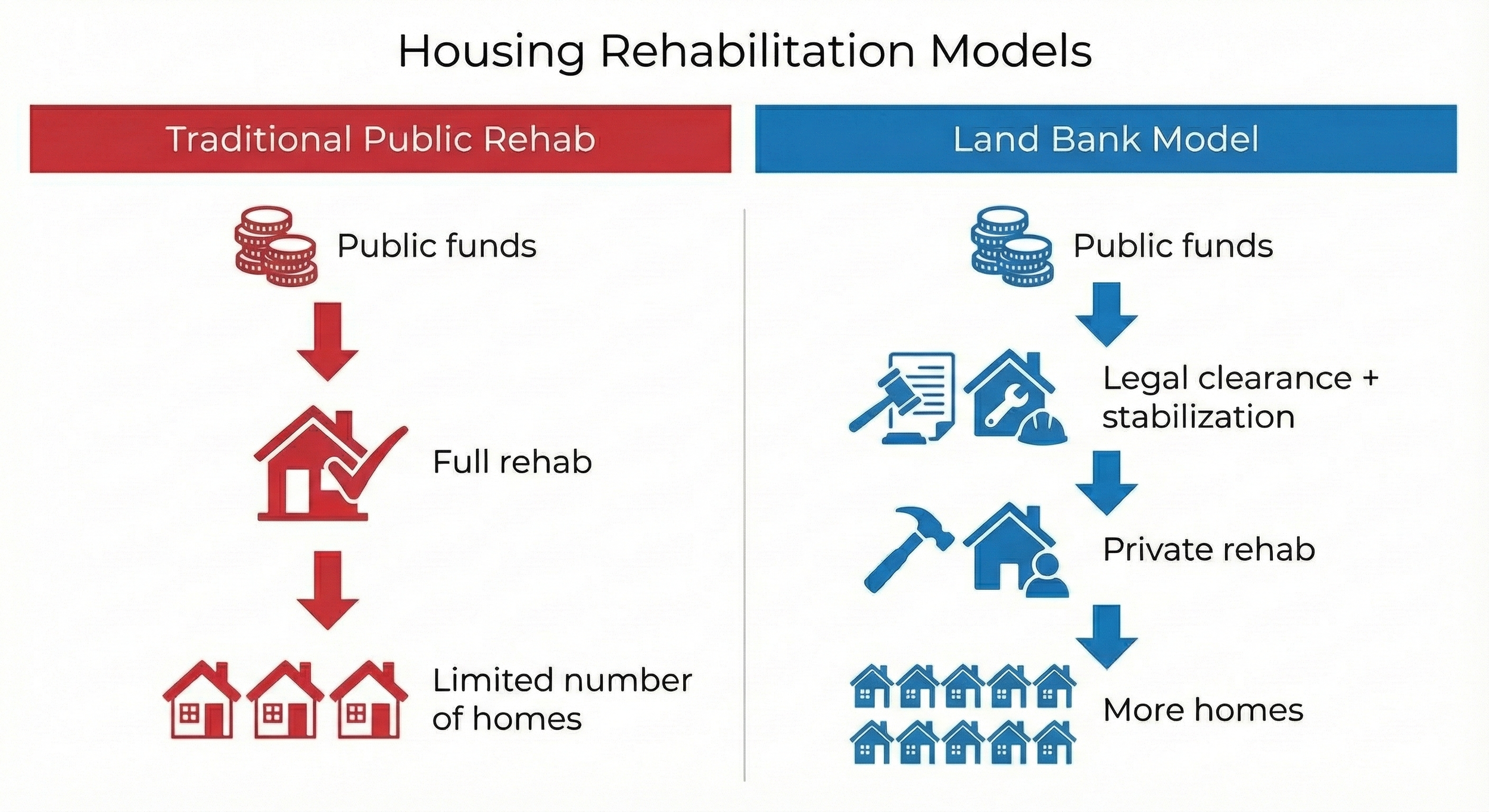
Long and inflexible project timelines
Flexible timelines based on property readiness
Public sector bears most financial risk
Risk shared with private investment
Higher per-property public cost
Lower per-property public cost
Targeted public investment focused on legal clearance and stabilization
Traditional Public Rehabilitation
Our Model
High upfront public construction costs
Renovation completed by private buyers or contractors
Public agency manages full renovation
More homes addressed with the same public resources
Limited number of homes addressed
Why This Matters for Affordability and Community Impact
By reducing upfront public costs and removing legal barriers, the Land Bank model helps create pathways for local homeownership and responsible redevelopment.
This approach discourages speculation, supports neighborhood stability, and ensures that public investment leads to long-term community benefit rather than short-term gain.
The result is a model that balances fiscal responsibility with social impact.